
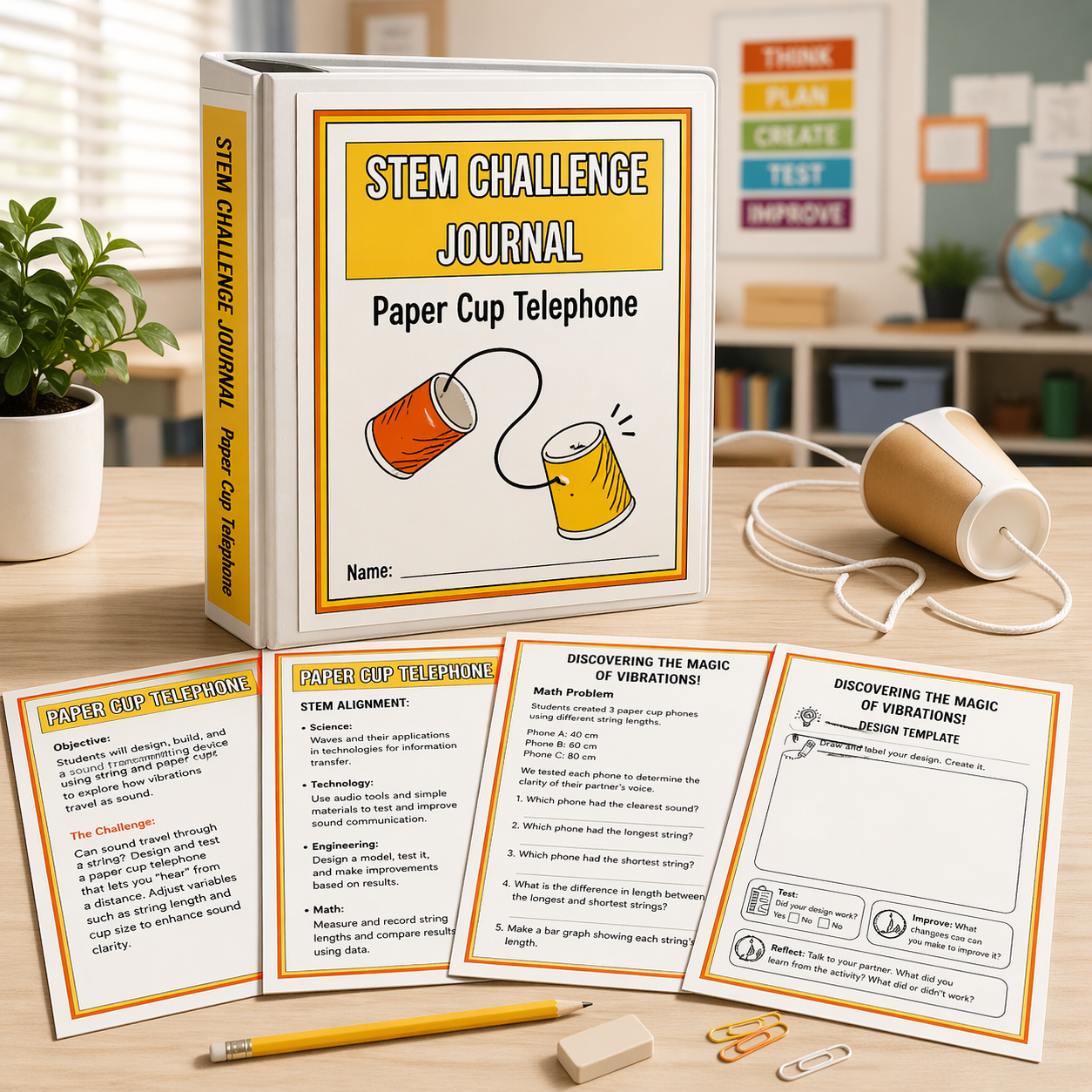

Description
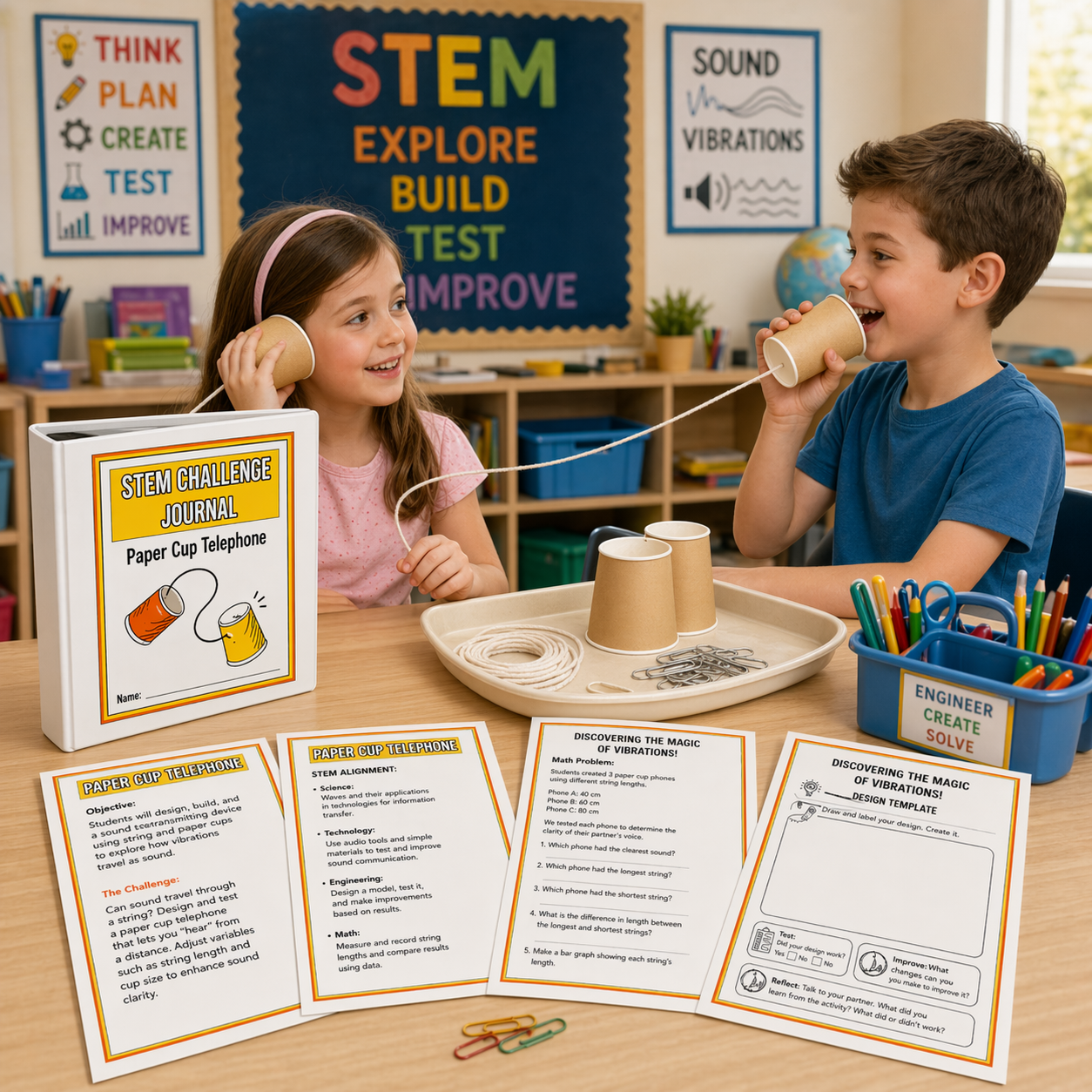
Bring science to life with this interactive STEM Challenge Journal designed to help students explore how sound travels through vibrations in a fun, meaningful way.
In this hands-on activity, students will design, build, test, and improve their own paper cup telephone, while developing a deep understanding of sound energy, communication, and engineering design.
This resource goes beyond a simple experiment—it provides a structured learning journey where students:
- Ask questions
- Plan and design
- Test and analyze
- Reflect and improve
Perfect for inquiry-based learning, STEM centers, or project-based lessons, this journal supports both scientific thinking and real-world problem-solving skills.
WHAT’S INCLUDED
✔️ STEM Challenge Cover Page (student-friendly & printable)
✔️ Objective & Challenge Explanation Page
✔️ NGSS & STEM Alignment Page
✔️ Detailed STEM Learning Breakdown (Science, Tech, Engineering, Math)
✔️ Student Planning Template (Ask, Imagine, Plan)
✔️ Design & Build Worksheet
✔️ Test & Improve Reflection Page
✔️ Math Integration Worksheet (data, measurement, comparison)
✔️ Extension Activity (problem-solving & analysis)
✔️ Assessment Rubric (easy teacher grading tool)
PERFECT FOR
✔️ Grades 2–5 students
✔️ Science lessons (Sound & Vibrations)
✔️ STEM / STEAM activities
✔️ Project-Based Learning (PBL)
✔️ STEM Days / Innovation Week
✔️ Homeschool parents
✔️ After-school programs & workshops
✔️ Sub plans (easy-to-follow structure)
SCIENCE NGSS ALIGNMENT
- 1-PS4-1: Waves and Their Applications in Technologies for Information Transfer
- 2-PS1-1: Plan and conduct an investigation to describe and classify materials
- 2-PS1-2: Analyze data to determine which materials have suitable properties
- 4-PS3-2: Energy can be transferred from place to place (sound/vibrations)
- 3-5-ETS1-1: Define a simple design problem
- 3-5-ETS1-2: Generate and compare multiple solutions
- 3-5-ETS1-3: Plan and carry out fair tests
👉 Focus: Sound energy, vibrations, and engineering design
MATH CCSS ALIGNMENT
- 2.MD.A.1: Measure length using standard units
- 2.MD.D.10: Represent data with graphs
- 3.MD.B.3: Draw scaled picture/bar graphs
- 4.MD.A.1: Solve measurement problems
- 5.MD.B.2: Represent and interpret data