Description
Take your students on a global STEM adventure 🌍✨
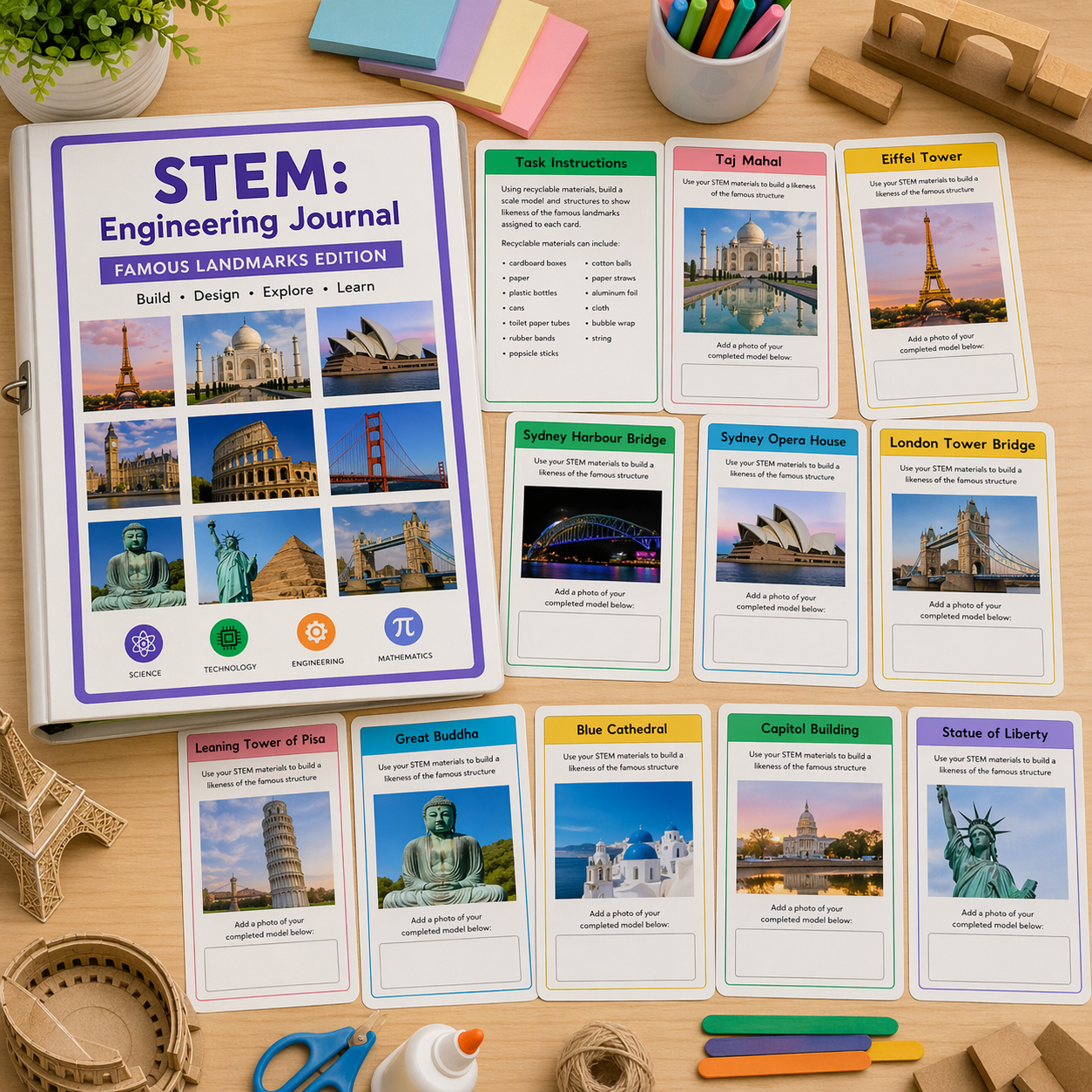
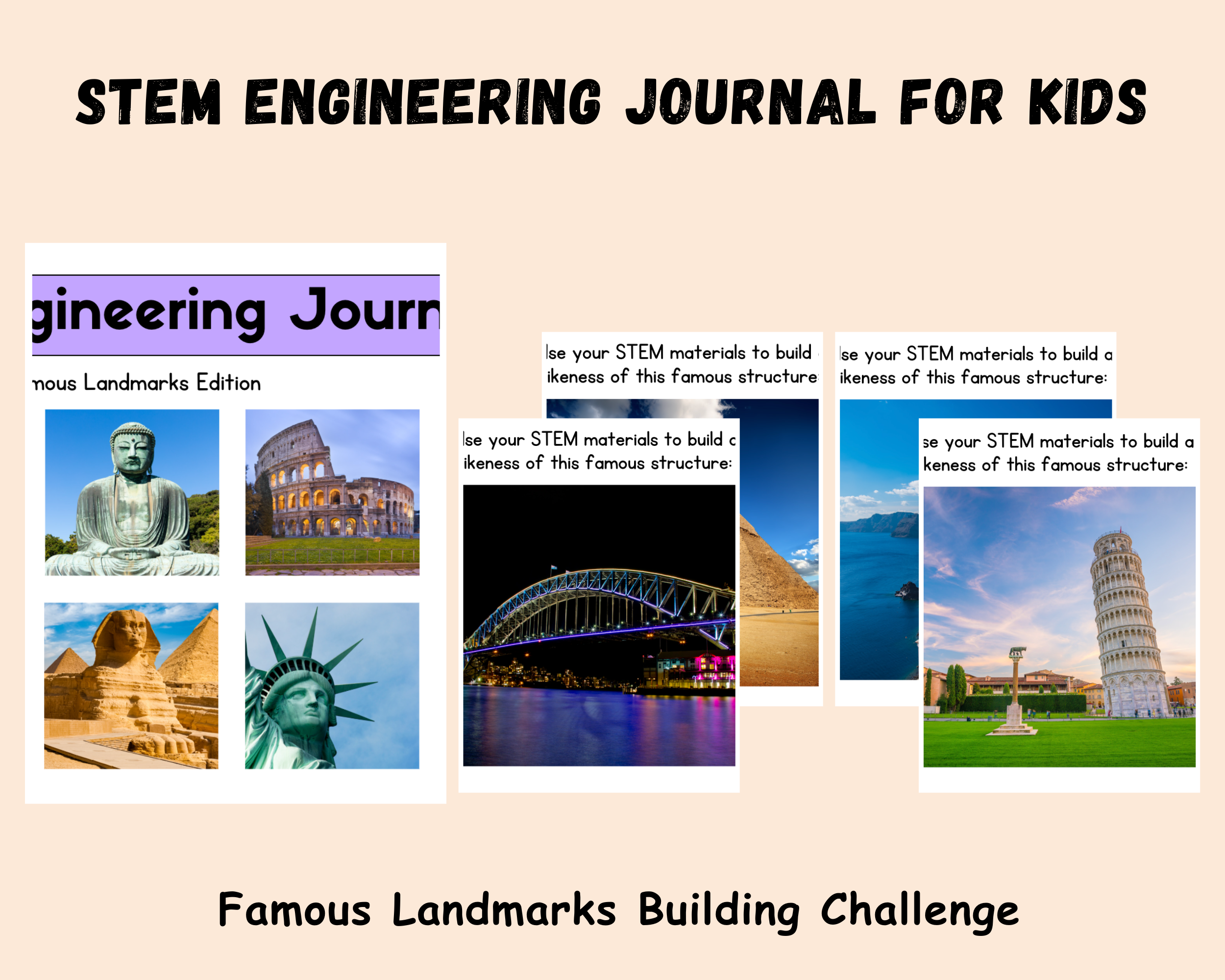
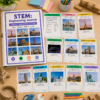
The STEM Engineering Journal: Famous Landmarks Edition is a hands-on, project-based learning resource designed to help students explore engineering, creativity, and problem-solving while building models of iconic structures like the Eiffel Tower, Taj Mahal, and Golden Gate Bridge.
Instead of passive learning, students actively:
- Design
- Build
- Reflect
- Improve
Each page guides learners through a real-world engineering challenge using simple materials, making STEM accessible, engaging, and meaningful.
This resource supports NGSS-aligned engineering practices and integrates CCSS skills through reading, writing, and structured thinking.
Perfect for:
- STEM lessons
- Project-based learning (PBL)
- Classroom challenges
- Homeschool activities
- After-school programs
- Family STEM nights
WHAT’S INCLUDED
✔ STEM Engineering Journal Cover
✔ Task Instruction Page (materials + challenge explanation)
✔ 15+ Landmark Challenge Pages, including:
- Taj Mahal
- Eiffel Tower
- Sydney Harbour Bridge
- Sydney Opera House
- London Tower Bridge
- Leaning Tower of Pisa
- Great Buddha
- Blue Cathedral
- Capitol Building
- Statue of Liberty
- Golden Gate Bridge
- Pyramids of Giza
- The Sphinx
- Big Ben
- London Eye
- Colosseum
✔ Space for:
- Student-built model photo
- Reflection / thinking
- Design iteration
✔ Printable + Digital Use Friendly
PERFECT FOR
- Grade Level: Grades 2–6 (flexible differentiation)
- Teachers (STEM / Science / Math / PBL)
- Homeschool parents
- STEM workshop facilitators
- After-school clubs
- Parents who want meaningful screen-free learning
SCIENCE NGSS ALIGNMENT
Aligned with key Next Generation Science Standards (NGSS):
- 3-5-ETS1-1: Define a simple design problem
- 3-5-ETS1-2: Generate and compare solutions
- 3-5-ETS1-3: Plan and carry out fair tests
- MS-ETS1-1: Engineering design process
Supports Science & Engineering Practices:
- Developing models
- Designing solutions
- Problem-solving through iteration
MATH CCSS ALIGNMENT
Math (CCSS.MATH):
- Measurement & geometry (structure, scale)
- Problem-solving & reasoning
- Mathematical modeling